SkyWatch : Atmospheric Injection
Chemtrails, covert weather ops, and the truth above our heads—this SkyWatch report explores what’s happening in our skies.

Greetings, Intrepid SkyRider,
Welcome to the tenth edition of SkyWatch, a weekly flight operations review from AVIAR LABS. In this week’s SkyWatch were covering a topic of growing controversy, atmospheric injection, more commonly known as chemtrails.
In an age where public trust is fraying and narratives are more manufactured than revealed, it’s essential we return to first principles—discernment, observation, and data. Atmospheric injection is no longer a fringe theory—it’s a documented, operational reality. But the full extent of it, who’s behind it, and why it’s happening remains murky. This SkyWatch report cuts through the fog and takes a clear-eyed look at the aircraft, operations, and organizations actively modifying our skies. Whether you’re a seasoned aviator, curious skeptic, or policy analyst, this report aims to equip you with the tools and understanding to see beyond the official story.
Lets dive in...
SkyWatch Target : [ Atmospheric Injection ]
In the skies above us, something curious is unfolding. On any given day, aircraft carve their way through the atmosphere, leaving behind trails of white. To some, these are innocuous contrails—the expected product of jet exhaust meeting cold, humid air. To others, they hint at something far more deliberate: evidence of covert atmospheric injection programs. While mainstream sources dismiss such ideas as unfounded, a deeper examination reveals a topic layered in complexity, historical precedent, and credible voices urging transparency. As seasoned observers of both aerospace operations and institutional narratives, we take this moment to explore the known, the unknown, and the deliberately obscured.
Understanding Contrails: A Foundation in Atmospheric Science
Contrails, short for condensation trails, occur when hot, moist engine exhaust from high-flying aircraft meets the frigid temperatures and low vapor pressure of the upper troposphere. These trails are made of ice crystals, formed when water vapor condenses and freezes around microscopic particles in the exhaust. When atmospheric conditions are dry, contrails may vanish within seconds. In humid layers, however, they can persist, spread, and eventually morph into cirrus cloud formations.
This process is well understood in meteorology. Persistent contrails are not inherently unusual and do not require chemical additives to form. That said, their longevity and evolution into large cloud decks can sometimes resemble the visual outcomes of intentional cloud seeding or aerosol dispersion—and herein lies the root of the controversy.
When Contrails Mimic Injection Events
Under specific atmospheric conditions, persistent contrails can blanket the sky, creating haze and reducing solar irradiance. These conditions typically involve high humidity, low temperatures (below -40°C), and stable wind layers that prevent dispersal. In such scenarios, contrails may appear to “grow” unnaturally, fanning out in grid-like patterns due to intersecting flight paths. To the casual observer, or even the trained meteorologist, distinguishing these from engineered injection trails can be difficult without detailed flight data and atmospheric readings.
It is precisely this overlap—between naturally persistent contrails and potential aerosol injection events—that invites scrutiny. Given that contrails can, under certain conditions, seed cirrus cloud formation without additional particulate input, we must develop more nuanced observational tools to differentiate between natural and artificial phenomena.
Atmospheric Injection: Weather Modification and Beyond
There is no question that atmospheric injection is a real and documented practice. Weather modification programs have been conducted in dozens of countries for over 70 years. They generally fall into three categories:
Rainfall Enhancement
Used to combat drought and increase water availability, this form of weather modification involves dispersing substances such as silver iodide or salt into clouds to encourage precipitation. Countries like China, the UAE, Thailand, and the United States have conducted thousands of such missions, often using twin-engine aircraft at altitudes between 10,000 and 25,000 feet.
Hail Suppression
Designed to minimize crop damage, hail suppression missions also use silver iodide to disrupt the hail formation process in storm cells. These flights often follow convective storm boundaries, operating near the lower and mid-levels of thunderstorm systems.
Climate Geoengineering
Still mostly in the experimental phase, this controversial approach seeks to mitigate climate change by injecting aerosols (like sulfur dioxide) into the stratosphere to reflect sunlight. Programs such as Harvard’s SCoPEx and rogue initiatives like Make Sunsets have raised international debate. These operations are intended to occur at much higher altitudes (approximately 60,000 ft), requiring high-performance aircraft or balloon platforms.
In each of these domains, the goal is clear: to alter atmospheric conditions to produce a desired weather outcome. The science behind the methods is often straightforward, but the broader implications—environmental, geopolitical, and ethical—remain unresolved.
The Delivery Systems: Aircraft, Drones, and High-Altitude Balloons
Atmospheric injection is most commonly achieved via:
Twin-engine piston aircraft for low- to mid-altitude seeding
Modified turboprops and jets for regional-scale dispersal
Unmanned aerial systems (UAS) for emerging, lower-cost options
Stratospheric balloons for high-altitude geoengineering experiments
Flight patterns for seeding missions typically involve racetrack or zigzag loops along weather fronts or over target basins. These can resemble, but are distinct from, the straight-line grid patterns of aerial mapping (see my previous report here) or commercial jet traffic. When seen repeatedly in the same geographic zones with meteorological correlation, such flights warrant attention.
Directed Energy and Electromagnetic Weather Manipulation
Beyond chemical injection, some have theorized that high-frequency electromagnetic radiation may influence atmospheric conditions. Projects like HAARP, ostensibly dedicated to ionospheric research, have been accused of manipulating weather systems by heating upper-atmospheric layers.
The process involves two phases: first, injecting metals or other EMF-absorbing particulates into the atmosphere; second, bombarding the targeted area with focused radio frequencies that excite the particulates and artificially heat the surrounding air mass. The result is large-scale steering of weather systems. When executed with coordinated precision, this technique may also accelerate or inhibit the development of weather phenomena such as hurricanes or tornadoes.
While official explanations deny such capabilities, patents and military whitepapers from past decades explore such possibilities in considerable detail. Ionization towers, ground-based plasma generators, and microwave-based fog dispersal systems have also been proposed or tested. Though often labeled as fringe or speculative, these technologies exist in the military-industrial dialogue. Whether they are in active use remains a topic ripe for inquiry.
The Case for Discernment: Whistleblowers, Patents, & Public Silence
While many in academia and government deny the existence of large-scale covert injection programs, whistleblowers and declassified documents suggest a more complex picture. Numerous patents exist for aerial aerosol delivery systems. Former military and aviation personnel have come forward alleging participation in or knowledge of covert injection activities.
Though skeptics are quick to cite peer-reviewed studies debunking so-called chemtrails, discerning observers understand that peer review is not immune to institutional bias. History offers countless examples—from MKUltra to the Tuskegee experiments—where official narratives concealed morally dubious programs.
To that end, it is not irrational to question whether atmospheric injection occurs beyond public consent. Open-source flight tracking, spectroscopic analysis, and whistleblower testimony should all be considered valid components of any serious investigation.
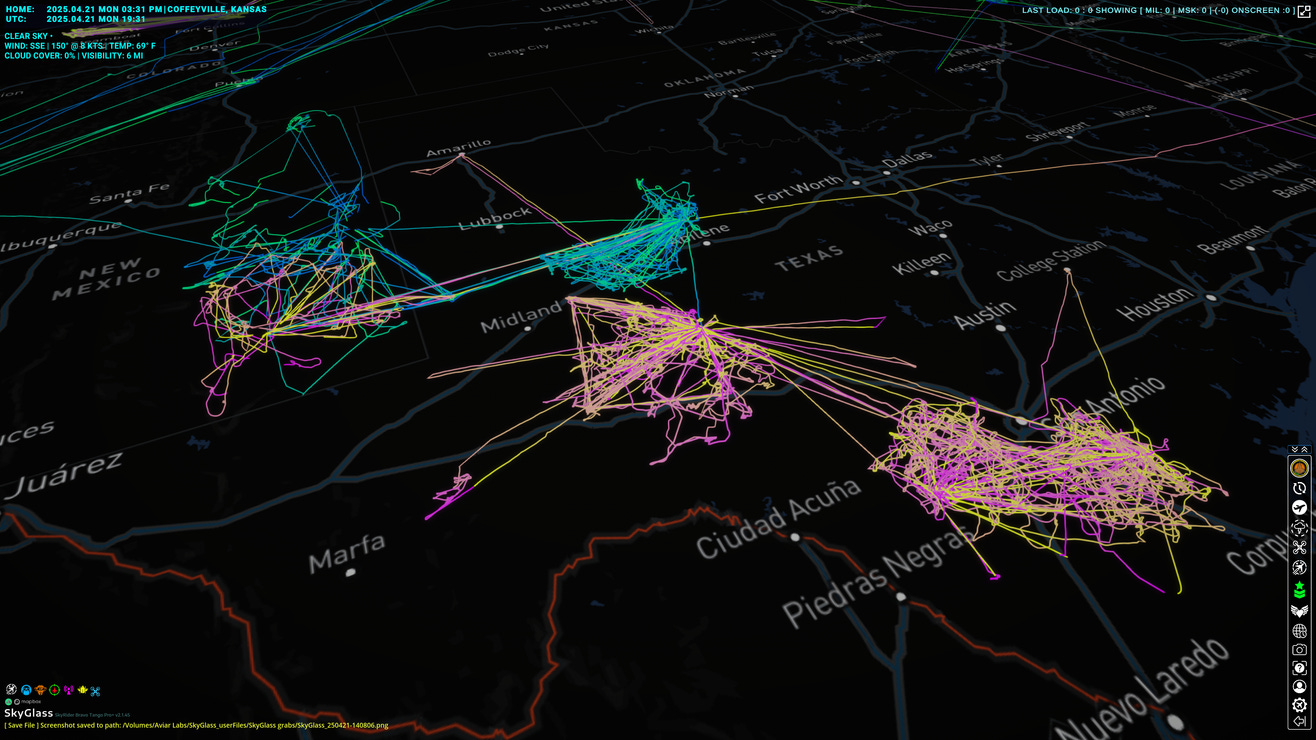
Image above: Flight activity from the past 12 months showing concentrated weather modification operations across Texas.
Entities Actively Involved in Atmospheric Injection
The following is a summary of organizations and companies currently or recently involved in various forms of atmospheric injection. These have been grouped by their primary mission area:
Rainfall Enhancement
Weather Modification International (WMI) - Fargo, USA
North American Weather Consultants (NAWC) - Utah, USA
UAE National Center of Meteorology (NCM) - Abu Dhabi, UAE
China Meteorological Administration - China-wide
Thailand Royal Rainmaking Project - Thailand
Saudi National Center for Meteorology (NCM) - Riyadh, KSA
In addition to well-known national programs, data from the SkyGlass aircraft database reveals a number of lesser-known yet active U.S.-based weather modification operators—specifically those engaging in rainfall enhancement:
South Texas Weather Modification Association – Texas, USA
Weather Modification LLC – North Dakota, USA
West Texas Weather Modification Association – Texas, USA
Hail Suppression
Alberta Hail Suppression Project - Canada
North Dakota Cloud Modification Project - USA
France (ANELFA) - Southwest France
Russia (Roshydromet/Military) - Various regions
Climate Geoengineering
Make Sunsets - USA/Mexico
Harvard SCoPEx (Proposed) - USA
Australian Cloud Brightening Project - Great Barrier Reef, AUS
These programs range from overt, state-sponsored initiatives to speculative or experimental projects. Collectively, they form the foundation of a broader weather modification framework—one that deserves close scrutiny and ongoing inquiry.
Legal and Regulatory Landscape
Globally, the legal framework surrounding atmospheric injection and weather modification is fragmented and inconsistent. While many nations engage in weather modification for agricultural or environmental purposes, few have cohesive national or international policies to govern these activities transparently. The 1977 ENMOD Treaty (Environmental Modification Convention) prohibits the hostile use of environmental modification techniques, including weather alteration, but applies only in the context of warfare. It leaves open a gray area regarding civilian and commercial applications, which are largely self-regulated by participating countries.
In the United States, weather modification is overseen at the federal level by the National Oceanic and Atmospheric Administration (NOAA), which requires operators to report cloud seeding activities. However, the system is largely administrative and lacks rigorous enforcement mechanisms.
Over the past decade, individual states have taken steps to address increasing public concern about atmospheric injection. As of this writing, more than thirty U.S. states have seen legislative proposals—some passed, others still in committee or rejected—pertaining to aerial atmospheric activities.
These laws fall into several categories:
Prohibitive Legislation
Licensing and Disclosure Requirements
Resolutions and Moratoriums
Health and Air Quality Additions
For instance, Florida is currently advancing legislation to ban the release of chemicals into the atmosphere for the purpose of altering temperature, weather, or sunlight intensity. Similarly, Tennessee enacted a law in April 2024 prohibiting such activities within the state.
Enforcement remains minimal or symbolic in most cases. No state has yet established an agency with the authority or technical capability to monitor atmospheric injection at scale. Most enforcement mechanisms, where proposed, rely on existing environmental or aviation authorities.
Conclusion: Toward a Culture of Discernment
Not all contrails are chemtrails. But not all atmospheric injection is benign, acknowledged, or openly governed. As aviation professionals and curious citizens, we must cultivate a discerning eye—one that respects the rigor of science but questions the motives behind its public presentation. The sky, after all, is a shared domain.
As we deepen our exploration of atmospheric injection and its implications, let us do so with humility, courage, and a commitment to seeking truth beyond the boundaries of official narratives. Our skies deserve nothing less.
~•~
That concludes this week’s SkyWatch report. However, before you go…
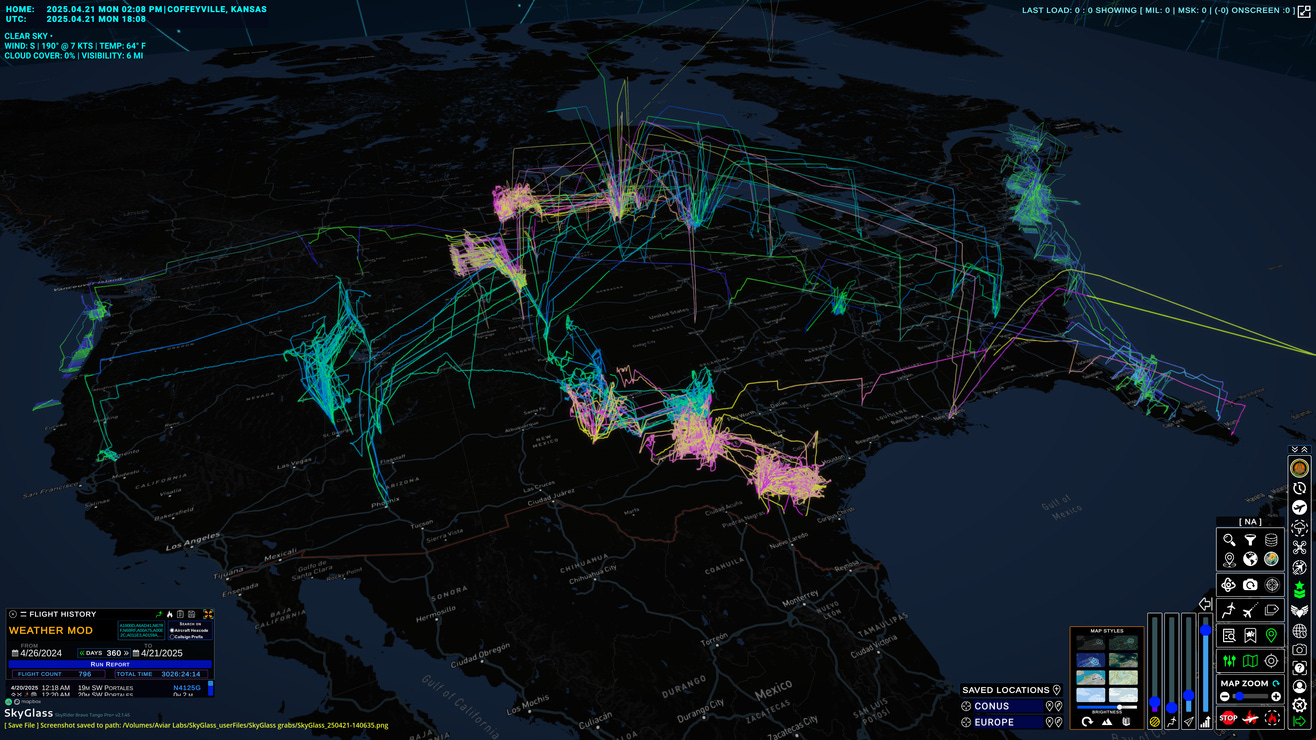
If this topic has stirred something in you—curiosity, concern, or a desire to verify what’s really happening above your region—SkyGlass Pro+ offers the most advanced aviation intelligence tools available. Included in this report are actual screenshots from SkyGlass showing flight traces of registered weather modification aircraft over the last 90 days, a task completed in just a few clicks within the SkyGlass platform.
With SkyGlass Pro+, you can search aircraft by callsign, registration, or owner, investigate flight tracks using Flight History Mode, and even set up Overwatch geofences to log every aircraft penetrating a designated region. Want to go back in time and see how atmospheric patterns and operations evolved over the past four years? Time Travel Mode unlocks a rich archive of data and 3D visual intelligence—unmatched by any other tool in the public or commercial sector.
Ready to take flight? Find out more here.
Your skies tell a story. It’s time we learn how to read it—and ask the right questions.
Best regards,
Goa
Creator of SkyGlass
